
Electricity spot prices and industrial loads
Large industrial energy users in the National Electricity Market are exposed to wholesale spot prices that can vary from a few dollars per megawatt-hour to thousands of dollars within the same day. For operations consuming megawatts of continuous load, even a few hours of high-price exposure per month represents significant cost.
Most sites manage this manually - an energy manager watches the price, calls the control room when it spikes, and operators try to shed load before the price interval closes. This approach works imperfectly. Price spikes are often brief, the five-minute settlement interval moves faster than a manual process, and operators have other priorities.
Automating the price response changes the outcome. When the control system is reading live price data and responding in seconds rather than minutes, the window of high-price exposure narrows and the cost saving improves.
Who this applies to
Real-time price integration is relevant to any industrial operation with significant electricity exposure and loads that can tolerate brief interruption. It is not limited to mining or sugar - the underlying principle applies wherever large motors, pumps, or compressors are running on a spot-exposed contract.
Water utilities and irrigation - pump stations with downstream storage or tank capacity can shed pumping load during peak price periods and restore it once prices fall. Treated water storage and distribution reservoirs act as a natural buffer. Aeration systems at wastewater plants often have flexibility within process limits.
Industrial gas and processing facilities - compressor loads and process equipment with upstream or downstream buffer can be managed against price signals. Operations that run large reciprocating or centrifugal compressors continuously are often well-suited to automated demand response.
Fertiliser and chemical plants - energy-intensive batch or continuous processes where brief load reduction does not affect product quality or safety can participate in price-responsive control. Pre-positioning before a forecast spike - completing an energy-intensive step early - is often viable in these environments.
Mining and materials handling - dewatering pumps, ventilation fans, and conveyor systems with buffer storage are established candidates for load management. Shed strategies are designed around operational constraints so production is not affected.
Sugar and agribusiness - milling operations with significant drive loads, irrigation pump stations, and processing plant with inherent storage can all benefit from price-responsive automation.
The common thread is energy exposure and interruptible load - not sector. If your site has large motors or compressors running continuously on a spot-passthrough contract, a price integration assessment is worth considering.
How we implement it
Price feed integration - connecting to a live AEMO data feed providing current and forecast spot prices for the relevant NEM region. Configured to poll at a frequency that supports the response time required by your load management strategy.
Control system logic - PLC or energy management system logic that reads the price feed, compares against configurable thresholds, and triggers load actions according to the approved shed strategy. Threshold values and response strategies are configurable by authorised engineering staff without requiring program changes.
Load shed sequencing - defining which loads shed in what order, the conditions required for safe shedding, interlock requirements, and the restart sequence when prices fall back below threshold. Developed with your operations team and encoded in the control system logic.
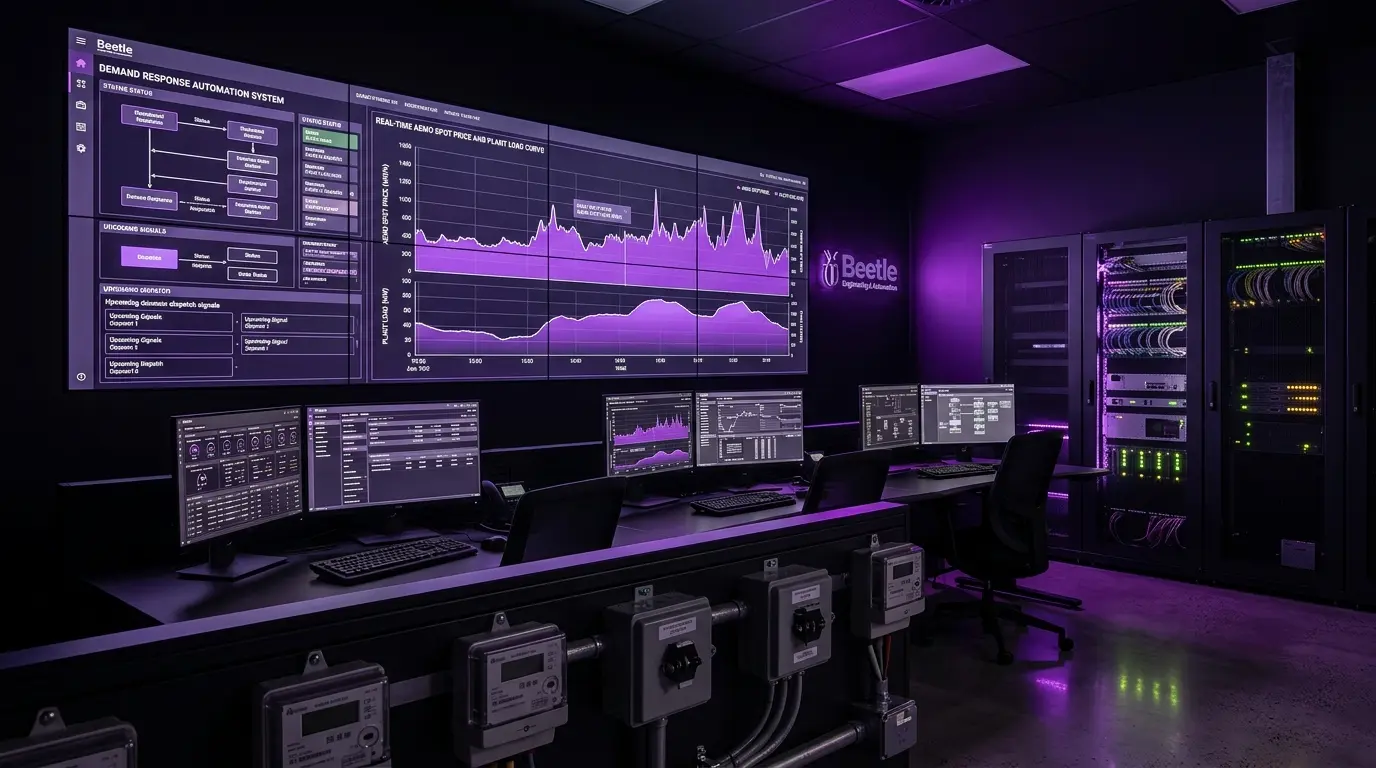
Operator interface - SCADA or HMI display showing the current price, forecast price trend, active thresholds, loads available for shedding, and current automation status. Operators see the same information the automation is acting on and can override at any time.
Logging and reporting - recording of price events, automated actions taken, manual overrides, and estimated cost impacts. Used for post-event review, reporting to management, and refining the shed strategy over time.
Forecast-based pre-positioning
Spot price spikes are often foreseeable. AEMO publishes pre-dispatch price forecasts that extend 30 to 60 minutes ahead. A control system that reads forecast prices as well as current prices can pre-position loads - filling tanks, running ahead of schedule - before a price event occurs, reducing the demand that needs to be shed when the high price arrives.
This requires slightly more sophisticated logic than reactive shedding and needs to be designed carefully to avoid creating operational problems through over-zealous pre-positioning. We design these systems conservatively, with clear limits on how far the automation will deviate from normal operating patterns without operator confirmation.
Working within operational limits
Every load management strategy has boundaries set by process requirements. A mine dewatering pump cannot be shed if the sump is approaching high level. A crusher cannot be stopped if the downstream process has no buffer. We design price response systems to respect these constraints as hard limits - the automation never compromises process safety or operational integrity to respond to a price signal.
The strategy is agreed with operations before implementation and encoded in the system. What can shed, under what conditions, for how long, and what restarts first - these are engineering and operational decisions made before the automation runs, not during it.